
On this page
The short answer for 2026
For years, National Registry certification meant two exams: a computer cognitive exam and a hands-on psychomotor exam at a skills site. That is no longer how it works at every level.
For AEMT and Paramedic, the National Registry says a psychomotor examination is not required and will not be counted in the new testing process. All psychomotor test authorizations expired on June 30, 2024. For EMR and EMT, you still prove your hands-on skills, but through a process your state EMS office approves.
If you read an older guide that lists National Registry skill stations, treat it as history, not as your exam.
EMR and EMT: your state sets the skills check
The National Registry requires EMR and EMT candidates to meet a state EMS office approved BLS skills competency requirement. In its words, the BLS psychomotor examination process is established and approved by each state, and that did not change with the new exams.
What this looks like depends on your state and your course. In many programs the skills checks happen inside the course itself, signed off by instructors. Others use a separate skills test day. Ask your program director exactly which skills sheets you will be tested on and who signs off.
Your course completion and skills verification are what let you apply for the cognitive exam. Your course stays valid for the National Registry for 2 years from the month and year you completed it.
Keep copies of your signed skills sheets or course completion record until you are certified, in case your program or state asks for them again.
Check yourself
4 quick questions on this topic
Question 1 of 4
A pedestrian struck by a car has blood spurting from a thigh wound, is moaning and has snoring respirations. In the primary assessment, your first action is to:
Answer: A. Massive external bleeding can kill within minutes, so current trauma care controls it before or at the same moment as the airway. The snoring airway is next and may be handled by a partner at the same time, but on your own the spurting wound comes first. Counting rates and checking pulses tell you what the bleeding is already doing.
Question 2 of 4
Which patient found during your primary assessment is the highest transport priority?
Answer: A. Priority is set by threat to airway, breathing or circulation, and a weak pulse with a depressed level of consciousness is both a perfusion problem and an airway risk. A deformed ankle with intact distal pulses is painful but not time critical, and controlled bleeding is by definition no longer a life threat.
Question 3 of 4
During the primary assessment of a trauma patient you find severe bleeding from a thigh wound. You should:
Answer: A. A femoral wound can exsanguinate a patient faster than an airway problem will kill them, which is why massive hemorrhage is corrected the moment it is found rather than deferred to a later step. Sequence in the primary assessment is about what kills soonest, not a fixed running order.
Question 4 of 4
You applied a tourniquet to a bleeding leg and continued the primary assessment. Two minutes later the dressing beneath it is soaked again. The correct action is:
Answer: A. Continued bleeding means arterial flow has not been stopped, and the fix is more pressure, either by tightening or by adding a second device proximal to the first. Loosening a tourniquet to let blood back in restarts the hemorrhage you controlled and costs volume the patient cannot spare.
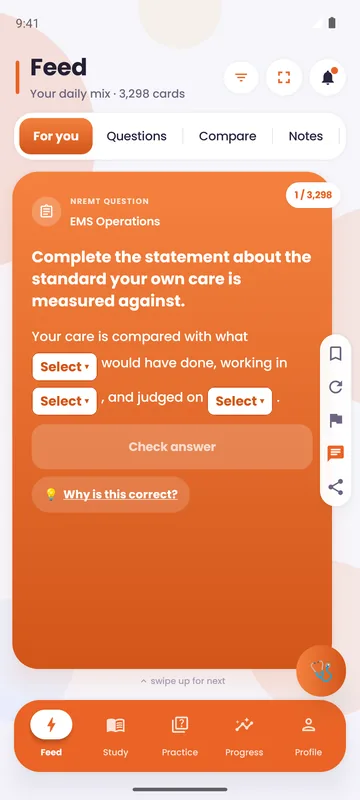
Keep the streak going with more questions like these, each with a full rationale.
AEMT and Paramedic: competency moved into the program
When the new AEMT and Paramedic exams launched on July 1, 2024, the separate National Registry psychomotor exam ended. Skills are now verified while you train.
Paramedic programs document a psychomotor competency portfolio for students who started after August 1, 2016, and the CoAEMSP Student Minimum Competency (SMC) Matrix for students who started after January 1, 2023. AEMT candidates must meet the AEMT SMC Matrix as of July 1, 2024. Your program director verifies that you have completed these before you can test.
For paramedics this also ties to the education requirement: you must complete a CAAHEP-accredited program, or one with a CoAEMSP Letter of Review, within 2 years of testing.
What the cognitive exam looks like now
With the skills check handled earlier, the cognitive exam is the National Registry exam you sit. For EMTs it is a computer adaptive test of 70 to 120 items, 10 of them unscored pilot items, with 2 hours to finish. You can take it at a Pearson VUE test center or through Pearson OnVUE remote proctoring.
AEMT is a fixed-length exam of 135 items (35 unscored) in 3 hours. Paramedic is adaptive, 110 to 150 items (20 unscored) in 3.5 hours, at a test center only. All levels report pass/fail on a 100 to 1500 scale, with 950 as the passing point.
Clinical judgment is where the hands-on mindset shows up on screen. It is a scored domain on the AEMT exam (31 to 35 percent) and the Paramedic exam (34 to 38 percent).
From course to certification: the 2026 steps
With the skills check built into training, the path to National Registry certification is shorter than older guides suggest.
- Finish a state-approved course and its skills verification (EMR/EMT) or your program's competency requirements (AEMT/Paramedic).
- Apply in your National Registry account and pay the fee for each attempt: EMR $88, EMT $104, AEMT $159, Paramedic $175.
- Receive your Authorization to Test (ATT). It is valid for 90 days.
- Schedule with Pearson VUE. You can book up to one business day ahead.
- Bring an unexpired government-issued ID whose name matches your ATT.
- Check your National Registry account for results, usually within 2 to 3 business days. They are never given at the test center or by phone.
Older advice you can ignore
Plenty of study guides and forum threads were written before the change, so check dates on anything you read.
If a guide tells you to book a National Registry skills test site, prepare for a set of Paramedic skill stations, or retest failed stations through the National Registry, it describes the process that ended June 30, 2024. Today AEMT and Paramedic skills are verified inside your program, and your program director confirms you have met them.
If a guide describes the EMT cognitive exam as it was before April 7, 2025, its format details may be out of date too. The current EMT exam is 70 to 120 items in 2 hours, organized into five domains: Scene Size-Up and Safety, Primary Assessment, Secondary Assessment, Patient Treatment and Transport, and Operations.
How to prepare for both halves
Treat your skills sign-offs as exam prep, not paperwork. Talking through each step of a patient assessment out loud during skills practice is the same sequence the cognitive exam tests in scenario items.
For EMTs, Primary Assessment is the largest cognitive domain at 39 to 43 percent, followed by Patient Treatment and Transport at 20 to 24 percent. The CinnaEMS bank has 731 primary assessment questions, 567 treatment and transport questions and 609 clinical judgment questions. Use the quiz on this page to practice the decisions your skills training builds.
Frequently asked questions
Is there still an NREMT psychomotor exam?
Not for AEMT or Paramedic. The National Registry stopped requiring it on July 1, 2024. EMR and EMT candidates complete a state-approved BLS skills competency process instead.
Who gives the EMT skills test?
Your state EMS office approves the process, and it is usually run through your EMT program. Ask your program director how and when you will be checked.
Do paramedics have to pass a skills exam for the National Registry?
No separate one. Paramedic programs verify skills through a competency portfolio and the CoAEMSP Student Minimum Competency Matrix before you take the cognitive exam.
Can I take the NREMT exam online?
EMR and EMT candidates can take the cognitive exam through Pearson OnVUE remote proctoring or at a test center. AEMT and Paramedic exams are test-center only.
Keep studying
Sources
Checked against official sources
- nrNational Registry: AEMT and Paramedic Certification Examinationsnremt.org
- nrNational Registry: EMR and EMT Certification Examinationsnremt.org
- nrNational Registry: EMT Candidate Responsibilitiesnremt.org
- nrNational Registry: Paramedic Candidate Responsibilitiesnremt.org
- nrNational Registry: Examinations Contentnremt.org