
On this page
The EMT exam's five domains
The current National Registry EMT exam launched on April 7, 2025. It is organized by what you do on a call, not by body system. Here is how the scored items are weighted.
Primary Assessment: the biggest slice
Roughly four in ten scored items sit here, so this is where your study hours pay back most. Primary assessment is finding and fixing immediate threats to life: general impression, responsiveness, airway, breathing, circulation including major bleeding, and the transport priority decision.
Expect items that hand you a patient and ask what you do first. Know the order cold, and know when to stop and intervene before moving on. Airway, ventilation, oxygen, shock recognition and bleeding control all live here.
Study it as decisions, not lists. For each condition you learn, ask: what would I see in the first minute, and what would I do about it?
A useful drill: take one chief complaint, such as shortness of breath, and walk it through the whole primary assessment out loud. Name what you check, what finding would make you act, and what the action is. Repeat with chest pain, an unresponsive patient and major bleeding. Those patterns repeat across hundreds of exam items.
Check yourself
4 quick questions on this topic
Question 1 of 4
An electrician was shocked at the top of a ladder and fell to the ground. Your primary assessment must account for:
Answer: A. Two mechanisms acted on this patient, so you are looking for the respiratory and cardiac effects of current and for the airway, breathing and bleeding problems of a fall from height at the same time. Choosing one mechanism narrows the assessment to half the injuries, and it is usually the spectacular one that gets the attention while the quieter one does the killing.
Question 2 of 4
A pedestrian struck by a car has blood spurting from a thigh wound, is moaning and has snoring respirations. In the primary assessment, your first action is to:
Answer: A. Massive external bleeding can kill within minutes, so current trauma care controls it before or at the same moment as the airway. The snoring airway is next and may be handled by a partner at the same time, but on your own the spurting wound comes first. Counting rates and checking pulses tell you what the bleeding is already doing.
Question 3 of 4
Which patient found during your primary assessment is the highest transport priority?
Answer: A. Priority is set by threat to airway, breathing or circulation, and a weak pulse with a depressed level of consciousness is both a perfusion problem and an airway risk. A deformed ankle with intact distal pulses is painful but not time critical, and controlled bleeding is by definition no longer a life threat.
Question 4 of 4
A patient sitting on a curb has an obviously deformed, bleeding forearm. He is also breathing 30 times a minute and answers you only in single words. You should address:
Answer: A. A deformed limb draws every eye on the scene, but a rate of thirty with single-word answers is a failing breathing step, and that is what will kill him in the next few minutes. Treating the arm first because it is visible and bleeding lets the dramatic injury set the order of care, which is precisely the trap the fixed sequence of the primary assessment exists to prevent.
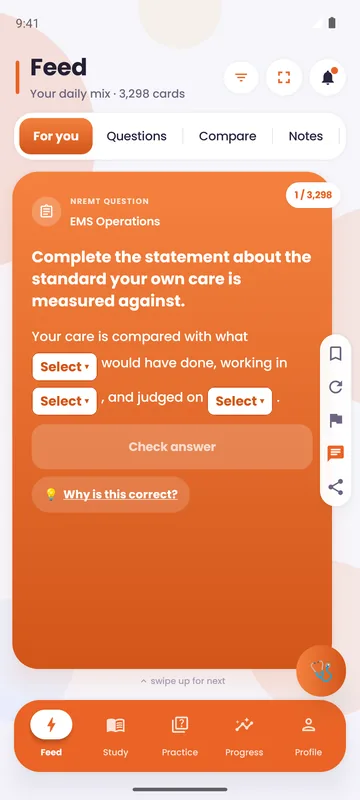
Keep the streak going with more questions like these, each with a full rationale.
Treatment, scene safety, operations, secondary assessment
Patient Treatment and Transport (20 to 24 percent) covers what you do after the primary assessment: interventions within the EMT scope, medications EMTs may assist with, and choosing where and how to transport.
Scene Size-Up and Safety (15 to 19 percent) is the call before you touch the patient: hazards, standard precautions, number of patients, mechanism of injury or nature of illness, and when to call for more resources.
Operations (10 to 14 percent) covers the work around patient care, such as communication, documentation, lifting and moving, and incident command. Secondary Assessment (5 to 9 percent) is the focused exam, vital signs and history. It is small, but its skills feed the decisions in the larger domains.
Do not skip the smaller domains. Together, Scene Size-Up and Safety and Operations make up roughly a quarter to a third of the scored items, and they are often the easiest points to secure with a few focused study sessions on hazards, resources, triage and safe lifting.
Know the format you'll study for
The EMT exam is computer adaptive: 70 to 120 items in 2 hours, 10 of them unscored pilot items. Right answers bring harder items and wrong answers bring easier ones. The exam stops once it is 95% confident about your ability against the standard, or when time runs out.
Besides standard multiple choice, you will see multiple-response items and technology-enhanced items such as build list, drag-and-drop and option or check-box items. A tutorial runs at the start. Results are pass/fail on a 100 to 1500 scale, and 950 is the passing point.
Results go to your National Registry account, usually within 2 to 3 business days, never at the test center. If you plan to move on to AEMT or Paramedic later, note that those exams add Clinical Judgment as a scored domain, so the decision habits you build now carry forward.
A four-week plan built on the weights
Spend your time roughly the way the exam does. If you have four weeks, give Primary Assessment the most of it and keep mixed practice going throughout.
If your first try doesn't go to plan
You have six chances to pass. You must wait 15 days after your last exam before retesting, and after three failures you need remedial education before the fourth attempt. Your course stays valid for 2 years from the month you completed it. The EMT exam fee is $104 per attempt.
Failing candidates get feedback against the passing standard, by area. Use it the same way you used the blueprint: put most of your hours on the weakest, heaviest domain.
How to study, not just what
The exam tests decisions, so study the way it asks. For each topic, write a one-line scenario and the first thing you would do. If you cannot name the first action, you do not know the topic well enough yet.
Practice ordering steps. Build-list items ask you to put actions in sequence, which rewards knowing the assessment order cold. Drag-and-drop and multiple-response items reward knowing which findings belong together.
Mix in pediatrics every week. Because pediatric items are spread across all five domains, saving children for the last weekend leaves gaps everywhere. Finally, build stamina: at least a few full 2-hour sessions on a screen before exam day, reviewing every miss by domain afterward.
Practice by domain
The CinnaEMS bank has 4,646 questions sorted by the National Registry domains, including 731 Primary Assessment, 567 Patient Treatment and Transport, 421 Scene Size-Up and Safety, 509 Operations and 373 Secondary Assessment questions. Start with the quiz on this page, then drill the domain where you score lowest.
Frequently asked questions
What is on the EMT exam?
Five domains: Primary Assessment (39–43%), Patient Treatment and Transport (20–24%), Scene Size-Up and Safety (15–19%), Operations (10–14%) and Secondary Assessment (5–9%), with pediatrics across all of them.
How many questions are on the EMT exam?
Between 70 and 120 items, including 10 unscored pilot items, with a 2-hour time limit.
What score do you need to pass the EMT test?
Results are pass/fail on a 100 to 1500 scale; 950 is the passing point. It is not a percent-correct score.
Is the EMT exam online?
EMT candidates can take the cognitive exam at a Pearson VUE test center or through Pearson OnVUE remote proctoring.
Keep studying
Sources
Checked against official sources